

Desiccants – Function, Types and Applications
Interview with Marco Nickel, Managing Director of TROPACK Packmittel GmbH
Desiccants are a proven means of preventing corrosion damage. How do desiccants work, what types of desiccants are available, and are they environmentally friendly?
Marco Nickel, Managing Director of TROPACK Packmittel GmbH, answers these and other questions in this interview.
During the storage and transport of metallic goods, climatic conditions can cause corrosion damage. It is therefore essential to protect products safely against moisture. A proven solution for this is desiccants, which can be used flexibly and easily and are ideally suited, among other things, to protecting metal parts and electronic components from moisture.
As simple and flexible as the use of desiccants may be in everyday packaging operations, a great deal of expertise lies behind them. In this interview, Marco Nickel, Managing Director of TROPACK Packmittel GmbH, provides a comprehensive overview of the following questions:
- How do desiccants work?
- What types of desiccants are there, and what are they used for?
- How do I know how much desiccant needs to be used?
- Are desiccants environmentally friendly, and how should they be disposed of?
- What new challenges exist in desiccant packaging, and what are the trends — for example ESD and automation?
1.How do desiccants work?
There are two categories of desiccants that function in fundamentally different ways:
1) Physically acting desiccants
Physically acting desiccants adsorb* moisture by taking up water vapour in their pores. These physically acting desiccants do not change their form during the adsorption process; in other words, they remain solid, retain their size with no change in volume, and are chemically inert.
From the outside, it is not possible to tell whether physically acting desiccants are saturated or still active. The exception is silica gels with indicators, such as orange gel or ruby gel, which change colour as adsorption progresses.
Through the adsorption of atmospheric moisture, these desiccants change only in weight: the more water vapour is adsorbed, the heavier the desiccants become.
2) Chemically acting desiccants
Chemically acting desiccants absorb* moisture and condensation water as part of a chemical reaction. These desiccants usually use calcium chloride as the key active substance. Calcium chloride is predominantly effective in environments with very high relative humidity and also absorbs condensation water.
Chemically acting desiccants change their form during absorption. Granulate, for example, often turns from an unsaturated state into a soft or gel-like mass after absorption, more than doubling its volume.
2. What types of desiccants are there, and what are they used for?
1) Physically acting desiccants
Physically acting desiccants can, almost without exception, come into direct contact with sensitive products such as food and medicines, as well as components such as electronics and optics. Physically acting desiccants are used in primary packaging or as a component in ongoing operation within machines and systems.
Within the group of physically acting desiccants, the following types are distinguished:
- Clay: Clay is the “standard desiccant” for desiccant bags and the most commonly filled desiccant in desiccant bags that comply with DIN 55473 — from the smallest 1/6-unit bags to the largest 32-unit desiccant bags.
Clay is a natural product mined from bentonite deposits around the world. - Silica gel: Due to its significantly higher adsorption capacity compared with clay, silica gel is the “standard desiccant” for very small desiccant bags — from 0.25 g to 5 g filling weight — or for applications with very limited installation space. Higher adsorption capacity means that less space is required.
In the pharmaceutical, diagnostics and food industries, silica gel is often the preferred desiccant. It is also filled into DIN 55473 desiccant bags, but in that case has the same adsorption capacity as DIN 55473 desiccant bags filled with clay.
Silica gel is an amorphous silicon dioxide that is produced chemically by acidifying water glass. - Orange gel / ruby gel (Silica gel with indicator): Silica gels can be combined with a colour indicator for visual monitoring of the desiccant’s saturation level. Based on the colour change of the desiccant, the user can see when the silica gel is saturated and needs to be replaced.
Orange gel and ruby gel are suitable for contact with food. These indicator gels are used, among other things, in applications where important parameters for calculating the desiccant requirement are unknown and where it is not clear exactly how much moisture needs to be adsorbed.
Thanks to the possibility of visual monitoring, orange gel and ruby gel are also ideally suited for long-term packaging. - Molecular sieve: Molecular sieve is characterised by special kinetic properties and is suitable for rapid adsorption — “sharp drying” — as well as applications with low relative humidity below 40% RH, for example cold chains.
In molecular sieve, the diameter of the pore, i.e. the “channel” in which moisture is bound, is precisely defined. The pore diameter is described in ångströms and, in addition to moisture uptake, also enables the adsorption of other molecules with a defined molecular diameter, such as gas decomposition products.
Molecular sieve is a crystalline aluminosilicate that is produced chemically by combining aluminium oxide with silicon dioxide.
2) Chemically acting desiccants
Chemically acting desiccants, especially calcium chloride salts, are not suitable as primary packaging materials because they can damage products in the event of direct contact.
The main application of chemically acting desiccants is container desiccant bags, which are placed outside primary packaging — such as wooden crates, big bags or closed cardboard boxes — during sea transport.
The purpose of these bags is, in particular, to absorb condensation water dripping from the inside of the container roof. For use in sea containers outside primary packaging, chemically acting desiccants are particularly well suited because they are especially efficient at high relative humidity levels and also absorb condensation water, often referred to as “container rain.”
The absorption capacity can reach up to 300% of the desiccant’s own filling weight at very high relative humidity levels above 80% RH.
3. How do I know how much desiccant needs to be used?
There is a German industrial standard — DIN 55474 — in which a formula is defined for calculating the required number of desiccant units. This formula can be used to calculate the amount of desiccant required for transport and/or long-term storage in order to adequately protect products in packaging against moisture.
The following parameters are taken into account in this formula:

With this formula, the exact amount of desiccant required can be determined while taking into account, among other things, the films used — such as PE or aluminium composite — the climatic conditions along the shipping route, and the relative humidity prevailing during the packaging process.
If a desiccant is used not only as packaging material but also as a component in the ongoing operation of assemblies, the formula from DIN 55474 can be used in the first step as a guide and rough estimate for the required amount of desiccant.
4. Are desiccants environmentally friendly, and how should they be disposed of?
Physically acting desiccants can be considered environmentally friendly, as they do not place an excessive burden on the natural environment. Accordingly, all physically acting desiccants can be disposed of with household waste for private end customers or with normal commercial waste for business customers.
Clay — the most commonly used desiccant — is even used as an additive in composting, for example to adsorb tannic acids during the composting of certain types of organic waste and thus prevent the compost from becoming acidic.
Standard desiccant bags in dustproof version “B” generally consist of a non-woven material with a plastic coating on the inside as the sealing medium — a bi-component material. For this reason, these desiccant bags are not 100% recyclable.
Chemically acting desiccants used as container desiccant bags outside primary packaging for sea transport are not environmentally friendly. As waste, chemically acting desiccants, which usually contain calcium chloride, must be disposed of as hazardous waste.
5. What new challenges exist in desiccant packaging, and what are the trends?
Automation: Regardless of whether desiccant bags are used as part of packaging or as a component — for example in electronic control units — the fully automated insertion or placement of desiccant bags into packaging or housings is increasingly coming into focus in order to avoid the costs of manual work steps.
There are numerous technical options for storing desiccant bags as bulk goods in water-vapour-protected silos, separating them automatically from there, and feeding them precisely into packaging — for example via pick-and-place robotic arms or via a “chute.”
It is helpful to consider the integration of a desiccant-bag feeding system from the very beginning when planning packaging lines. Existing systems can of course also be expanded to include a desiccant-bag feed, although retrofitting generally offers less flexibility.
In addition to making the packaging process more efficient, automated feeding systems have another positive side effect: by storing desiccant bags in water-vapour-tight silos, the packaging units for desiccant bags can be made significantly larger, which saves costs and reduces packaging waste.
ESD: In the electronics sector, special desiccant bags are used for packaging electronic components that are sensitive to electrostatic discharge — ESDS.
These so-called ESD-protective desiccant bags are made from an antistatically coated, dustproof non-woven casing material. Desiccant bags made from this special non-woven material are electrostatically dissipative in accordance with DIN 61340-5-3, as the surface resistance of these “ESD-protective” desiccant bags lies in the range of > 1 × 10⁴ Ω to < 1 × 10¹¹ Ω.
The marking on ESD-protective desiccant bags describes the electrostatic dissipative function with the corresponding symbol:

More than just moisture: There are increasingly sophisticated packaging solutions in which moisture uptake by standard desiccant bags is not sufficient to protect products adequately. As a result, specific properties of different desiccants are increasingly required, especially with regard to adsorption kinetics — the speed at which moisture is absorbed — and adsorption behaviour under different climatic conditions, such as cold chains with low relative humidity levels.
In addition, it is becoming increasingly important to adsorb not only pure water vapour but also other molecules, such as gases that can react with moisture. In such cases, chemical analysis can be used to select desiccants with a precisely defined pore diameter, enabling targeted adsorption of specific molecules.
More information about desiccants can be found here: https://www.tropack.de/en/desiccant-products
[* Note: Adsorption means that gases or liquids are bound to the surface of a solid. Absorption, on the other hand, means that these gases or liquids are bound inside the solid.]
Marco Nickel
Marco Nickel is Managing Director of TROPACK Packmittel GmbH, a leading manufacturer of desiccant bags made in Germany.
Having initially worked as a management consultant and project manager in the banking sector, he has been with TROPACK since 2016 and has in-depth knowledge in the field of desiccants.
The company, based in Lahnau-Waldgirmes, offers industry customers comprehensive consulting expertise and experience in the field of desiccants for packaging, industrial applications and transport.
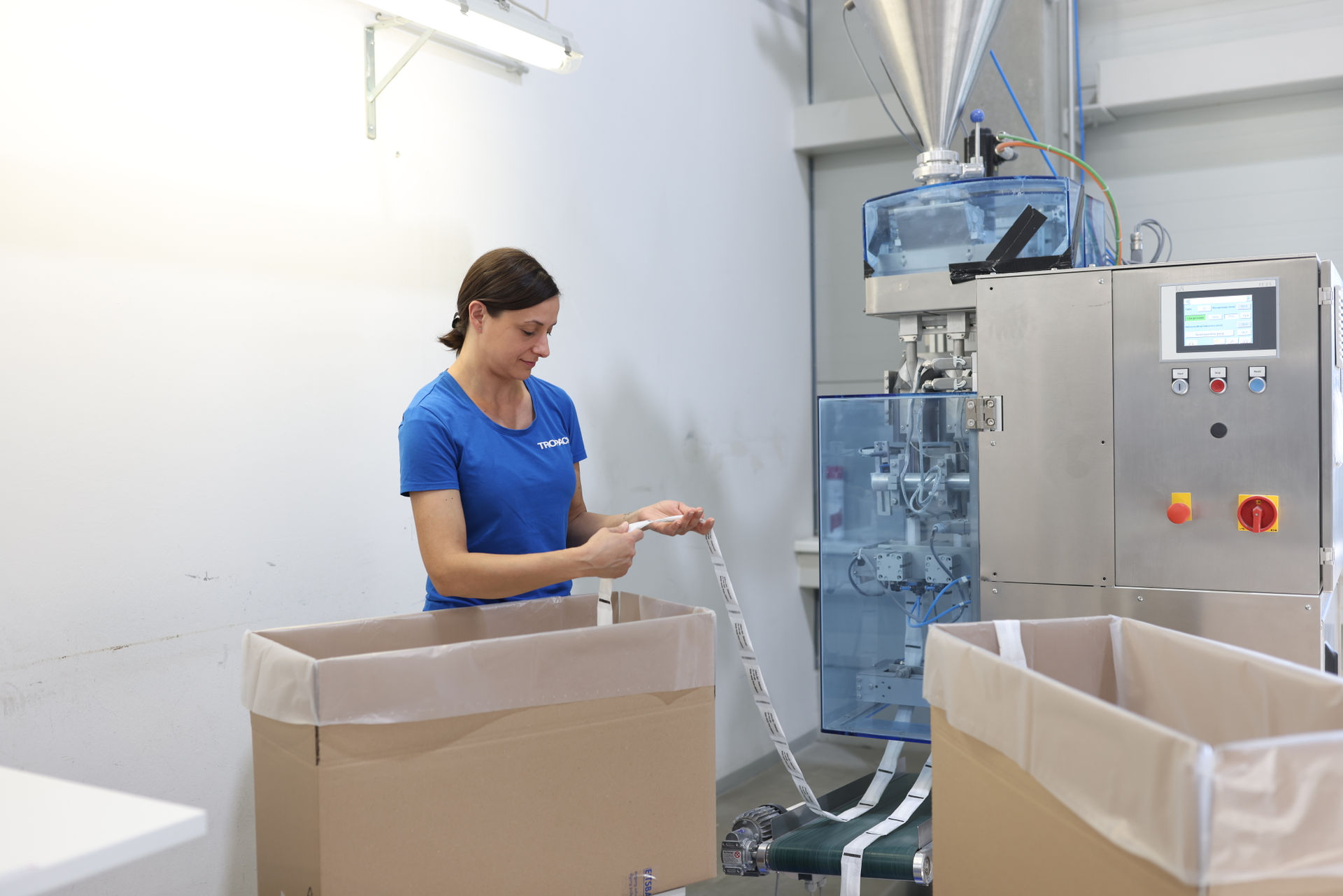

TROPACK – you can count on us
TROPACK products comply with the highest quality standards according to DIN 55473 (12/2015). Our desiccants meet the relevant requirements established by the European Union (e.g. EC 1935/2004) and the US Food & Drug Administration FDA (e.g. 21 CFR part 175/part 177).
TROPACK quality standards are regularly verified in the form of DIN 55473 and ISO 9001 certifications.That’s something industry, the retail market and consumers alike can count on. TROPACK desiccants are food-safe, contaminant-free, odourless and renewable. (We expressly refrain from using dimethyl fumarate (DMF)!)