

35 Years of Desiccant Expertise
Interview with Managing Director Marco Nickel on the Company Anniversary
Mr. Nickel, congratulations on your 10th anniversary.
You mean our “35th anniversary.”
Actually, there are two anniversaries: TROPACK was founded in 1991 and will celebrate its 35th anniversary on August 1, 2026. And you personally are also celebrating an anniversary: you joined the company ten years ago, in 2016.
That’s true, you’re right. Thank you very much.
How has TROPACK developed from your perspective?
TROPACK was founded in 1991 by Reinhard Kipke as a successor to a previous company. This allowed him to build on existing customer and supplier relationships, giving the business a solid start. Initially, the focus was on desiccants for the trading sector, primarily the distribution of standard desiccant products.
From this starting point, TROPACK evolved into a manufacturer of a wide range of desiccant solutions for packaging applications and as integrated system components. Over the years, our expertise in moisture protection has grown significantly, enabling us today to provide comprehensive consulting services on desiccants and their integration into our customers’ overall production processes.
Can you name some key milestones in the company’s history?
A major milestone was certainly our entry into the automotive sector in 2003, when our desiccants evolved from a packaging material into a system component within automotive applications. This represented a significant step forward economically, technologically, and in terms of quality standards.
Other important milestones include our product launches: in 2007, our first trademarked brand TROPAsorb® for condensation protection in sea freight containers; the indicator desiccants Rubingel and Orangegel from 2017 onward, which display the saturation level; TROPAgreen® in 2022 as a compostable desiccant pouch; and TROcarbon® this year for odor adsorption.
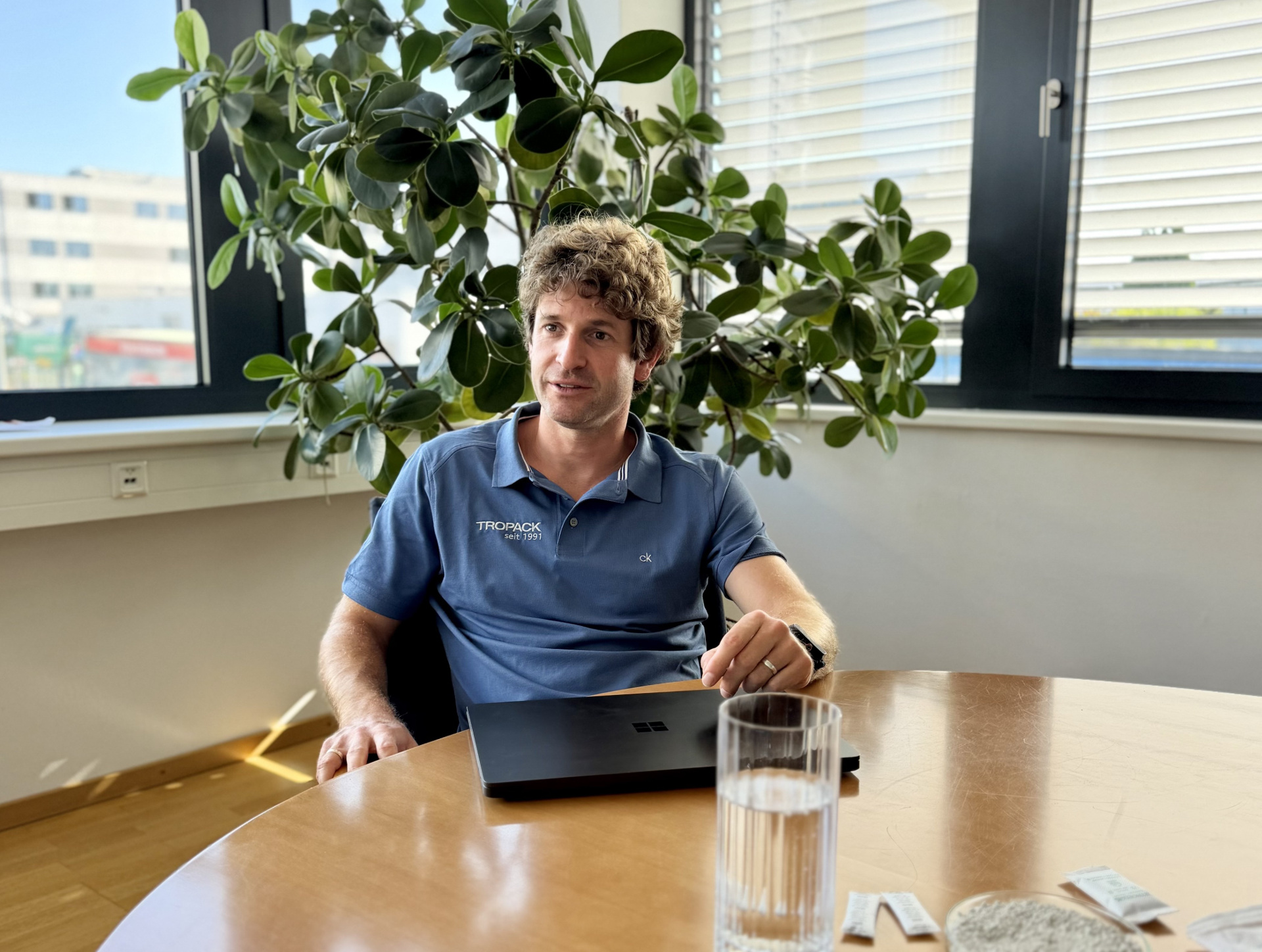
There are two additional key moments: our strategic focus on the pharmaceutical, healthcare, and food industries, which began when I joined the company, and the entry of Gebhardt Holding as a shareholder in 2022, securing the company’s succession planning for the long term.
How have the requirements placed on desiccants changed over time?
On the one hand, regulations and requirements for moisture protection have become significantly more stringent, including conformity requirements, labeling obligations, industry standards, and technical norms. Detailed customer audits have also become commonplace.
On the other hand, desiccants themselves have gained greater importance in customers’ perception.
What do you mean by that?
If I had to summarize it in a slogan: “From disposable item to life insurance.”
In the past, the products being packaged tended to have lower value—for example, metal components—so the desiccant was not considered quite as critical. Today, highly sophisticated and expensive products are manufactured in industries such as electronics, semiconductors, and telecommunications.
If components and products are damaged by moisture, the resulting costs are much higher. As a result, the importance of tailored desiccant solutions has increased substantially.
How do you assess the current market situation? What trends do you see in the desiccant industry?
The physical desiccants we use at TROPACK have not changed much from a technological standpoint; their adsorption-based mode of action remains proven and reliable.
What has changed more significantly is the way desiccants are delivered and integrated into production. Automated feeding solutions, such as desiccant pouch chains, are particularly in demand because customers continue to increase the automation levels of their manufacturing facilities.
This requires extensive consulting on our part, whether supporting process integration or helping customers select suitable machinery. Overall, the focus has shifted toward the entire packaging process rather than just the individual packaging component.
What are your goals for the coming years?
A key priority is our strategic expansion in the pharmaceutical and healthcare sectors, where we can leverage our regulatory expertise and consulting capabilities.
We have built up a specialized knowledge base that we share with customers to help them identify the most suitable desiccant solution for their individual healthcare products.
In addition, we want to continuously expand our product portfolio to provide customers with even more options. One example is the TROcarbon® pouches launched this year, which combine moisture protection with odor adsorption through the addition of activated carbon.
Activated carbon is only the beginning. We plan to introduce further products closely related to desiccant technology into our portfolio and are already working on new product developments.
What challenges do you see for the future?
Global crises and volatile supply chains will continue to affect businesses in the years ahead.
At the same time, increasing automation and digitalization are driving a greater need for personal technical consulting. With automated inquiries, it is easy for a detailed understanding of desiccants and their applications to be lost. That's why we always clarify the critical details in direct dialogue with our customers.
For more complex products, particularly desiccants used as components, regulatory requirements have been and will remain the biggest challenge. The onboarding process—with conformity declarations, framework agreements, liability issues, warranty periods, and similar requirements—is highly detailed, but worthwhile if it enables us to become a trusted partner for our customers.
Furthermore, we have been able to differentiate ourselves through supply reliability amid global supply chain uncertainties. Thanks to our location in Germany and our substantial inventories, we can largely insulate ourselves from global disruptions and deliver quickly throughout Europe.
We are local, we have the raw materials, we provide samples, and we remain personally available to our customers at all times.
Mr. Nickel, thank you for this anniversary interview.
TROPACK – you can count on us
TROPACK products comply with the highest quality standards according to DIN 55473 (12/2015). Our desiccants meet the relevant requirements established by the European Union (e.g. EC 1935/2004) and the US Food & Drug Administration FDA (e.g. 21 CFR part 175/part 177).
TROPACK quality standards are regularly verified in the form of DIN 55473 and ISO 9001 certifications.That’s something industry, the retail market and consumers alike can count on. TROPACK desiccants are food-safe, contaminant-free, odourless and renewable. (We expressly refrain from using dimethyl fumarate (DMF)!)